Two Centuries on the Towpath: What Great Bedwyn's Canal Still Teaches Us
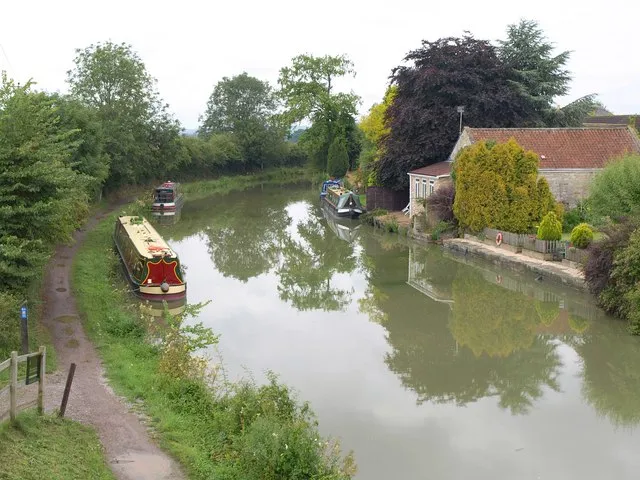
Photo: Derek Harper , CC BY-SA 2.0, via Wikimedia Commons
There is a particular sound the canal makes in early November. Not the clatter of a summer Sunday hire boat, but the slow tick of water finding its way past a half-raised paddle, and the clink of a windlass being laid down on a lock beam. Stand at Great Bedwyn wharf on a damp Saturday morning and you can hear it all — and, if you squint, you can almost hear the coal carts too.
Two hundred years is a long time for a ditch to hold its shape, but this one has. The Kennet & Avon was cut through this stretch of Wiltshire in the years around 1810, and although the barges stopped, the water did not. What follows is part history, part walk guide, and part excuse to stand about on a towpath talking to people who know far more than we do.
The ledger years
When the canal opened along its full length, Great Bedwyn found itself on a working trade route between London and Bristol, with a wharf, warehouses and a steady traffic in coal, timber, Bath stone and farm produce. The village was never a Bristol or a Newbury, but it had something better than grandeur: a position. Boats could be loaded here, horses changed here, and messages left here.
It is worth pausing on what that meant for ordinary households. Coal arriving by water was cheaper coal, and cheap coal meant a warmer winter and a hotter oven. The canal did not just carry cargo; it quietly rearranged the domestic economics of a village like ours.
The ledgers were never going to stay in credit. The railway came in the 1840s, took the freight, and left the canal to silt, freeze and be admired by the occasional eccentric. By the mid-twentieth century you could walk stretches of it without seeing a boat at all. The fight back — dredging, lock rebuilding, endless volunteer weekends — eventually reached its high point in 1990, when the restored waterway was formally reopened. And in 2010 the whole canal marked its bicentenary with bunting, beer and a great deal of speechmaking.
What the bricklayers left behind
You do not need a guidebook to read this canal, but it helps to know where to look.
Start with the lock chambers. Look at the brickwork on the wing walls and you will see the difference between the neat, regular courses of the original build and the patched, mismatched repairs of the last fifty years. Both are honest. The older bricks are softer and often slightly bowed; the modern ones are harder, pinker and a little smug about it.
Then look at the coping stones along the lock edge. Many carry a scooped hollow in the middle, worn by two centuries of rope sawing across them as boats were held while the water fell. Those grooves are the cheapest museum in Wiltshire.
Keep an eye out, too, for the small cast-iron and stone markers along the bank — boundary stones and company markers that once told a boatman exactly whose water he was floating on. Some are legible, some are nearly swallowed by grass. The numbers cut into bridge keystones are worth a look as well; they are the canal's own filing system, still intact.
And on the lock beams, the gate quoins and the paddle gear, notice how much of the ironwork that still does its job every day is either original or a faithful copy. This is not a preserved ruin. It is a machine that has been kept running.
The lock keeper's round
Rob Tanner has been a volunteer lock keeper at the Great Bedwyn end of the canal for six years. He is at the lock by half eight on a running day, in boots and a fleece that has seen things.
"People think it's just winding paddles," he says. "It's not. It's checking the levels first thing, clearing the rubbish out of the by-weirs, looking at whether a gate is sitting right, and knowing which boat is going to need a hand because the crew are brand new and slightly terrified."
His favourite part, unsurprisingly, is the people. "You get the same faces every year. The couple from Bristol who always stop for a cup of tea. The bloke who's been single-handing since before I was born. And the first-timers who arrive convinced they'll sink it, and leave three locks later looking like old salts."
What would he ask of the rest of us? Two things. Don't moor on the lock landing, and don't let your dog chase the ducks along the offside bank. Beyond that, he says, the canal looks after itself. Mostly.
A short walk from the wharf
Here is a route you can do in about an hour and a quarter without breaking stride or a sweat.
Start at the wharf, head east along the towpath, and follow the water as it curves away from the village. You will pass the first of the locks that bracket Great Bedwyn, then a long, quiet pound where the reeds are high and the herons are grumpy. Keep going and you will reach the next lock, and then the lane that leads up towards Crofton and its famous beam engines. That is roughly a mile and a half — forty minutes at a stroll.
Turn round there, or loop back through the lanes if the ground is dry. The whole thing is flat, the towpath is a public right of way, and the gates are all stiles or kissing gates, so dogs and pushchairs are fine in principle and muddy in practice.
In November, take a torch for the last half hour, wear something you do not love, and look up: the bare trees along the offside show you the shape of the cutting as the navvies cut it.
A historian's long view
Jenny Coles, who has spent years digging through the Bedwyn History Group's files, is brisk about the romance and precise about the facts.
"The wharf was the working heart of it," she says. "Coal in, corn out, goods for the shop, and a whole set of small trades that lived off the boats. When people tell me the canal 'died', I always say it went quiet rather than died. There were still boats, still water, still men with a living to make. It just stopped being the future."
Her point is a good one for anyone walking the towpath this month. We are not looking at a monument. We are looking at a piece of infrastructure that has been repurposed twice — once as a quiet backwater, and now as a kind of linear park, nature reserve, commute, gym and pub garden all at once.
Two hundred years and still counting
So what does the canal still teach Great Bedwyn? That things can be brought back, for a start, and that they usually are brought back by volunteers with mud on their knees. That a village's best asset is sometimes the one it stopped noticing. And that a groove worn in a stone is not damage — it is evidence that something worthwhile passed this way, repeatedly, for a very long time.
If you fancy helping, the Canal & River Trust takes volunteers for towpath work, lock keeping and practical conservation, and there is always a working party somewhere between here and Crofton. Or you could simply walk it, which is what most of us do, and which is — genuinely — the point.