Second Chances on a Saturday: The Volunteers Who'd Rather Mend Than Replace
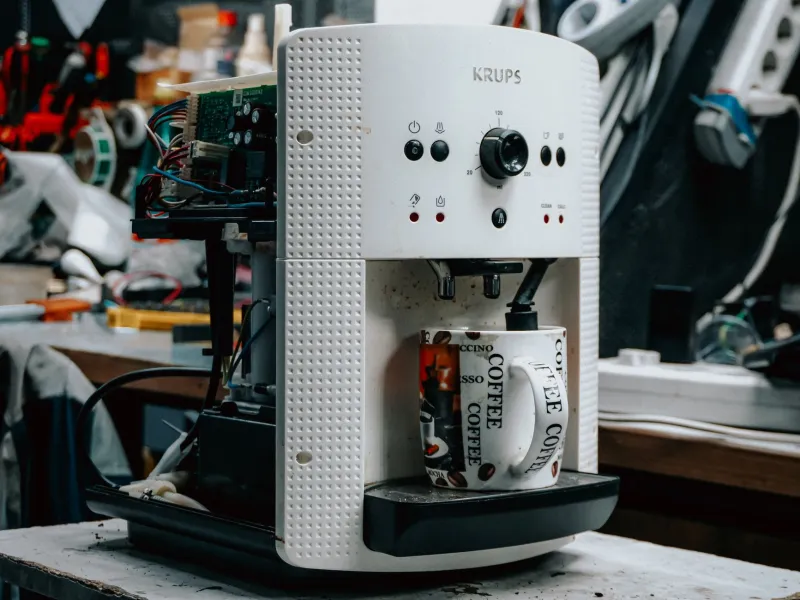
Nine forty-five on a Saturday morning and the village hall already smells of tea, warm dust and the faint hot-metal whiff of a soldering iron being coaxed into life. A trestle table has been dragged into position near the window. On it: a multimeter, three screwdriver sets, a tin of assorted fuses, a sewing machine that has seen better decades, and a plate of flapjack doing steady, unglamorous work.
By ten past, there is a queue.
Not a dramatic queue — this is Great Bedwyn, not a Boxing Day sale — but a steady trickle of people carrying things. A standard lamp held like a rolled carpet. A kitchen chair with a leg that has developed Opinions. A radio. A pair of secateurs. A wooden train set that a grandchild has loved slightly too hard.
The Rules of the Bench
The Repair Café runs on a simple bargain. You bring the broken thing. A volunteer has a look. If it can be fixed, it gets fixed, usually within the hour, usually for the price of a donation into the tin and a slice of something homemade.
There are caveats, and the volunteers are cheerfully honest about them. No guarantees. Nothing mains-powered gets plugged in until it has been checked. If a part is needed, you'll be told what to buy and invited to bring the item back next month. And if the honest answer is that the thing has had its chips, somebody will say so kindly and explain exactly why.
"People apologise," says Derek, who has spent the morning elbow-deep in a vacuum cleaner and is now wiping his hands with the thoroughness of a man who has learned the hard way. "They say sorry for bringing rubbish. But it's not rubbish, is it? It's a lamp. Somebody bought that lamp. It worked for fifteen years. It just needs ten minutes and a new switch."
What Comes Through the Door
Over the course of the morning, the tables fill up. There is a distinct rhythm to it: electrical first, because that is where the queue always forms, then textiles, then the slow, satisfying business of wood.
A toaster arrives with one slot that has given up entirely. It is opened, examined, diagnosed as a tired element, and declared fixable — but not today, because the element has to be ordered. The owner looks mildly delighted anyway. He leaves with instructions, a note of the part number on the back of a receipt, and the promise of a bench space in December.
A lamp is rewired while its owner sits with a cup of tea and chats to the woman next to her about a shared grandchild, discovered in the way these things usually are: entirely by accident, ten minutes into a conversation about school runs.
In the corner, a sewing machine is being fed a pair of jeans with a split knee. Further along, someone is reattaching a handle to a favourite mug — not a perfect job, and not pretending to be, but the mug will hold tea again and that is the whole point.
By half past eleven, the clipboard is filling in. Around forty items have come through the door. Roughly three-quarters of them will leave working or wearable or at least standing up straight. The rest will go home with a diagnosis, which the volunteers treat as a useful outcome in its own right. Knowing why the strimmer died is worth something, even if the strimmer cannot be saved.
The Long Drive to the Tip
There is a practical edge to all this that anyone who lives out here will recognise. The nearest household recycling centre is not at the end of the road. Getting rid of a broken lamp involves a car, a spare hour and a mild sense of defeat. Multiply that by a house, a shed and a decade, and it becomes easier to see why a bench, a screwdriver and someone who knows what they are doing is worth having on the doorstep.
It is also, quietly, about money. The volunteers do not lecture anybody about landfill or carbon, and the word "sustainability" barely gets a mention all morning. But everyone at the table knows that a new toaster costs about the same as a decent lunch, and that the old one is not actually broken so much as tired. Thrift is not a fashion here. It is just what you do.
"My dad fixed everything," says Sue, who has spent the morning on textiles and is now unpicking a hem with the calm of someone who has done this ten thousand times. "I thought everybody's dad did. It was only later I realised he was unusual — or rather, that the world had got unusual around him. Now people bring things here because they've never been shown. That's the bit I like. The showing."
Passing It Along
And that, more than the repaired lamps, may be the real output of the morning. Twice I watch a teenager being talked through the inside of a plug — not lectured, talked through — and twice I watch them do the last screw themselves, slightly too tight, while an adult very deliberately looks out of the window.
Another visitor, in her seventies, arrives with a broken necklace and leaves having been shown how to open and close the clasp so it doesn't happen again. She is not a customer. She is a person who now knows something she didn't at half past nine.
By noon the tables are being cleared. Chairs are stacked. The last two people are still at the far end, deep in a conversation about a lawnmower that has been in a shed since 2019 and may or may not be worth rescuing. The answer, as far as I can tell, is: possibly, and bring it in.
If You Fancy Going
The Repair Café meets on the first Saturday of the month in the village hall, ten until twelve. Turn up with something broken and a little patience; the queue is real but it moves, and nobody will make you feel foolish for not knowing what a fuse is. Tea and cake are on, donations go towards parts and hall hire, and if you have a skill worth sharing — electrical, woodwork, bikes, textiles, clocks, jewellery, sharpening — the volunteers would very much like to hear from you.
Next session is Saturday 5 December 2026. Bring the toaster. Bring the wobbly chair. Bring the thing you were about to put in the car and drive to the tip, and see what happens at the bench first.